
Water-Solvent Varnish × Carbon Nanotubes
Water-Solvent Varnish Enables High-Concentration Dispersion

Unexpected combinations, made possible by water.
As electronic devices rapidly evolve, the demand for high-performance materials is reaching unprecedented heights. Through our waterborne polyimide varnish, we discovered a breakthrough: it enables high-concentration dispersion of advanced materials and functionalizes general-purpose resins far more easily than conventional NMP-based systems. By leveraging waterborne polyimide in composite applications, our mission is to surpass the limits of existing materials.
Let's Surpass the Limits of Materials
Water-Solvent Varnish × Carbon Nanotubes
Features of UBE's Carbon Nanotube Dispersion
Achievement of High-Concentration Liquid
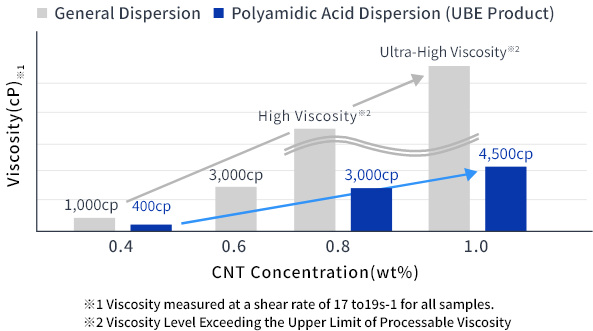
Because its viscosity is lower than that of general dispersions, it allows for increased concentration while maintaining handleability. A key feature of our dispersion is its resistance to viscosity increase, even when the CNT concentration is raised to 1.0wt%.
Cost Reduction

Because our dispersion concentration is 1.0wt% compared to 0.4wt% for general dispersions, a cost reduction of 50-60% per unit weight is possible.
Superior Storage Stability
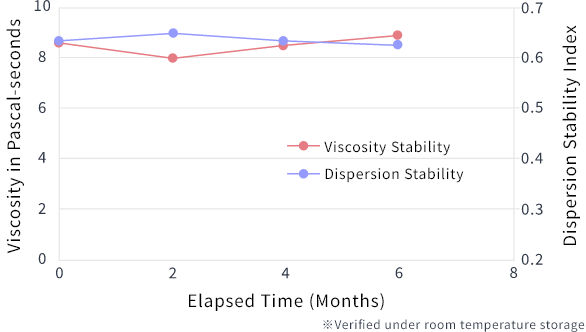
Superior storage stability prevents both a decrease in dispersibility and an increase in viscosity over time, even when dispersed at high concentrations. (In contrast, when dispersed in NMP-based varnishes, CNTs fail to de-agglomerate and easily precipitate.)
For example, it can be used in the following applications
EMI Shielding
Industry Examples Aerospace, Automotive, Electronic Equipment


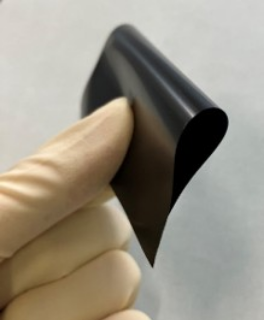
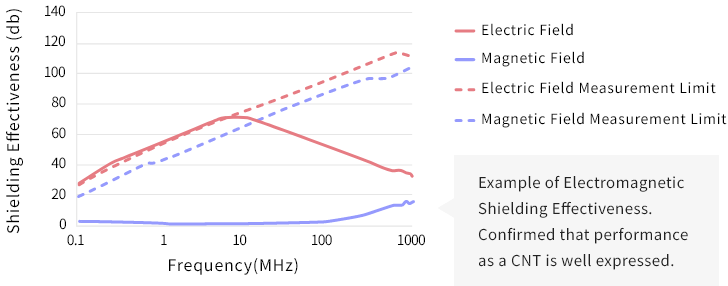
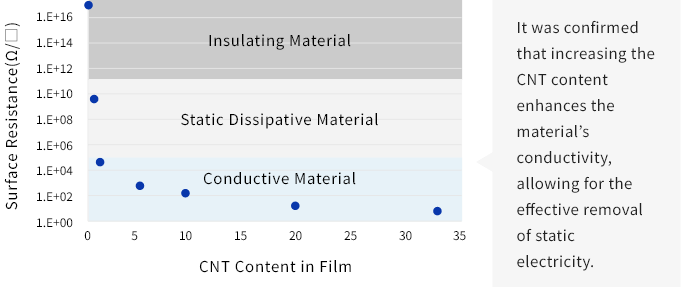
Antistatic Paint
Industry Examples Aerospace, Automotive, Electronic Components, Semiconductor


Benefits of dispersion with polyimide
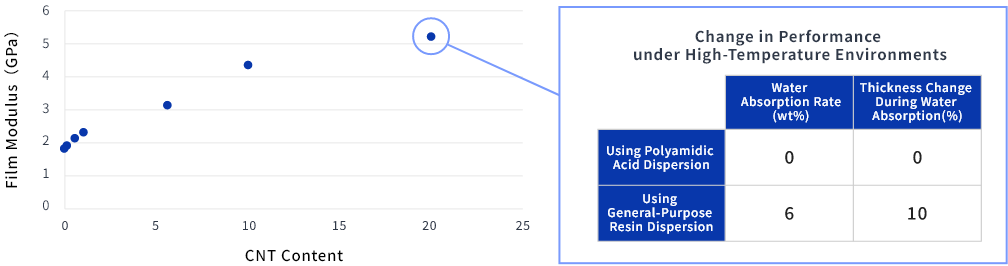
Because it is polyimide, high dimensional stability can be achieved.
We compared the effects of a high-humidity environment on CNT films using a polyamic acid dispersion with a 20 wt% CNT concentration versus a general-purpose resin CNT dispersion. While CNT films made with the general-purpose resin dispersion experience water absorption and dimensional changes, those made with the polyamic acid dispersion show no change in high-humidity environments, achieving outstanding dimensional stability.
Flowability Comparison of CNT Dispersions
※Samples shown from left to right
Polyamic Acid 1.0 wt%
CNT 0.4 wt%
CMC 0.6 wt%
CNT 0.4 wt%
Polyamic Acid 2.0 wt%
CNT 1.0 wt%
CMC 0.8 wt%
CNT 0.8 wt%
High-concentration CNT dispersions: Contact for details.
Contact UBE for sample data and application consulting
Frequently Asked Questions (FAQ)
-
What other applications can it be used for?
The following applications are anticipated:
- Insulating coating material for magnet wire
- Flexible circuit board material
- Heat-resistant paint/coating
- Dispersant
-
I would like to know the processing method.
The following processing methods are anticipated:
- Slot-Die Coating: Varnish is cast onto the substrate through a slit.
- Dip Coating: The substrate is immersed in the varnish, and the adhered varnish is squeezed off by rollers.
- Spray Coating: Varnish is applied directly and adhered to the material by spraying.
-
Is it possible to purchase your carbon nanotube dispersion?
Yes, it is available for purchase. Please feel free to contact us for inquiries, sample requests, or price quotes.
Product Lineup:
1.0 wt% Single-Walled Carbon Nanotube (SWCNT) Dispersion