
For those looking for composite products
For those looking for features that contribute to environmental sustainability
Both high strength and flexibility
| Water Solvent | NMP Solvent | |||
|---|---|---|---|---|
| Development Product ① | Development Product ② | Development Product ③ |
UBE Standard Grade (UPIA®-AT) |
|
| Glass Transition Temperature(℃) | 145 | 210 | 339 | 274 |
| Elongation Rate(%) | 199 | 164 | 96 | 92 |
| Tensile Modulus(GPa) | 1.9 | 3.2 | 4.6 | 3.7 |
| Tensile Strength(MPa) | 106 | 214 | 289 | 229 |
| Dielectric Breakdown Voltage(kV) | 6 | 6 | 7 | 8 |

The unexpected combinations made possible by water.
Currently, the world is seeing an advancement in the high-performance of electronic devices, driving the demand for enhanced functionality in materials. We have discovered that by using a water-solvent polyimide varnish, it is easier to achieve high-concentration dispersion of high-performance materials and to impart functionality to general-purpose resins than with NMP solvents. By utilizing water-solvent polyimide as a composite material component, we aim to surpass the limitations of various other materials.
Exploring the possibilities of composites.
Contact UBE for sample data and application consulting.
Let's Surpass the Limits of Materials
Water-Solvent Varnish ×
Carbon Nanotubes
Features of UBE's Carbon Nanotube Dispersion
Achievement of High-Concentration Liquid
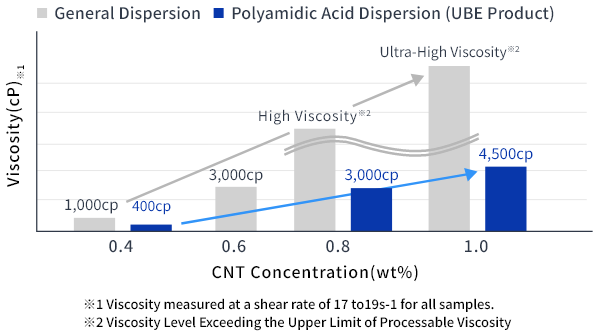
Because its viscosity is lower than that of general dispersions, it allows for increased concentration while maintaining handleability. A key feature of our dispersion is its resistance to viscosity increase, even when the CNT concentration is raised to 1.0wt%.
Cost Reduction

Because our dispersion concentration is 1.0wt% compared to $0.4wt% for general dispersions, a cost reduction of 50-60% per unit weight is possible.
Superior Storage Stability
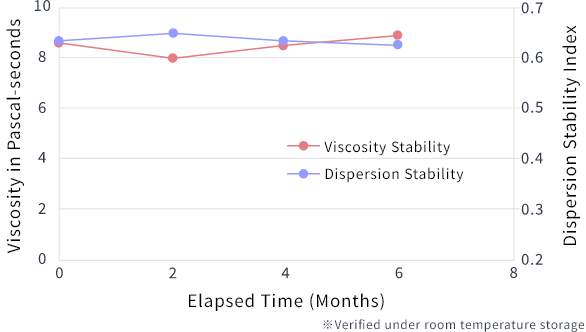
Superior storage stability ensures that decreased dispersion and increased viscosity do not occur over time, even when dispersed at high concentrations.
For example, it can be used in the following applications
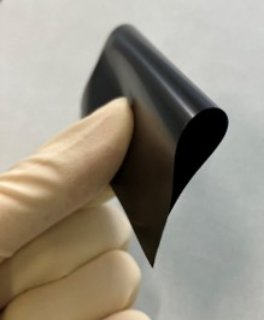
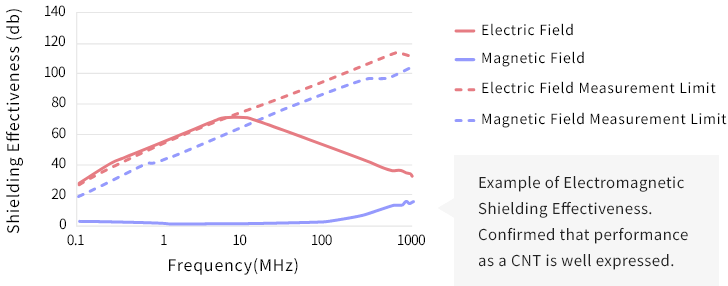
EMI Shielding
Industry Examples
Aerospace,Automotive,Electronic Equipment




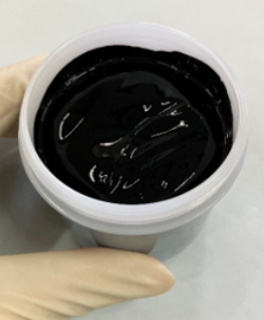
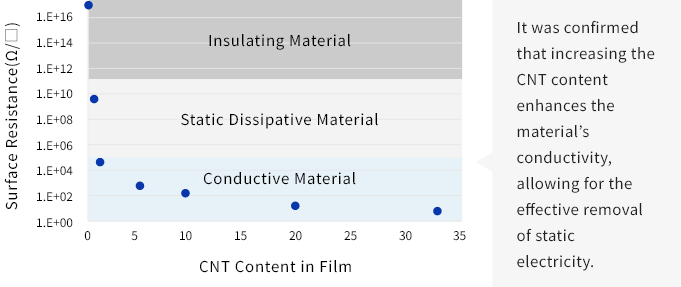
Antistatic Paint
Industry Examples
Aerospace,Automotive,Electronic Components,Semiconductor



Benefits of dispersion with polyimide
Because it is polyimide, high dimensional stability can be achieved.
A comparison was made regarding the effect of a high-humidity environment on CNT films using a polyamic acid dispersion with a 20wt% CNT concentration and a general-purpose resin CNT dispersion.
While CNT films made with the general-purpose resin dispersion undergo water absorption and dimensional change, CNT films made with the polyamic acid dispersion show no change in high-humidity environments, achieving high dimensional stability.
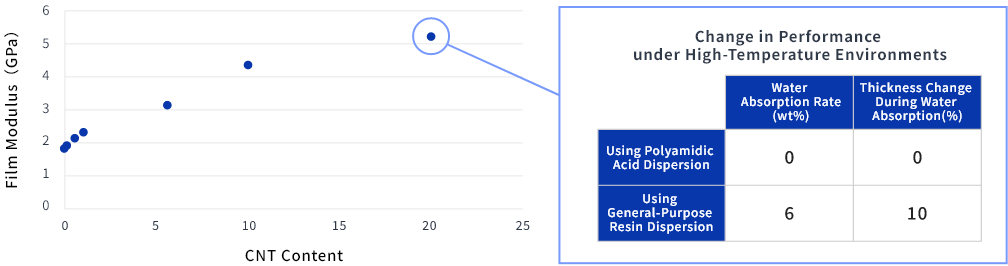
High-concentration CNT dispersions: Contact for details.
Contact UBE for sample data and application consulting.
Let's Surpass the Limits of Materials
Water-Solvent Varnish ×
General-Purpose Resin
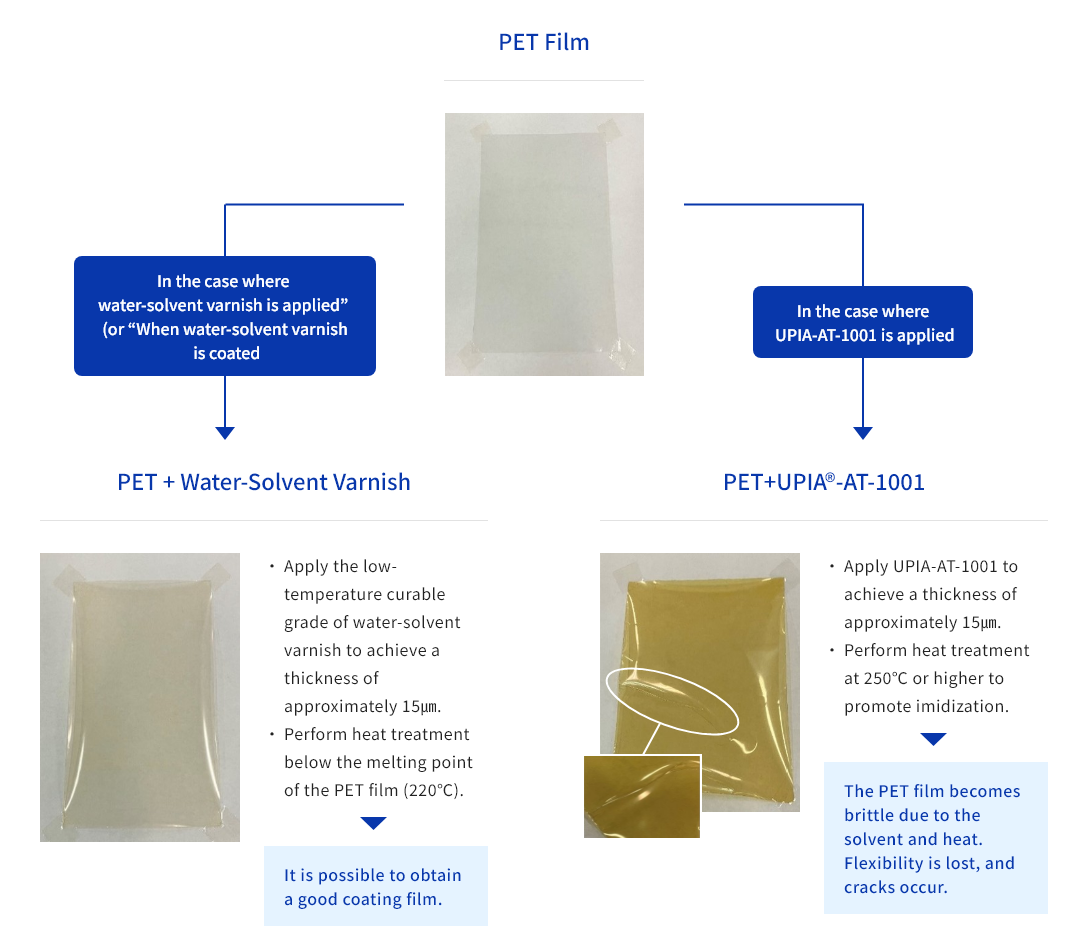
Furthermore, because we offer grades that cure at low temperatures, materials that were previously difficult to process due to deformation at high temperatures can now be easily fabricated.
With water-solvent varnish, coating and heat treatment on PET film is also possible.
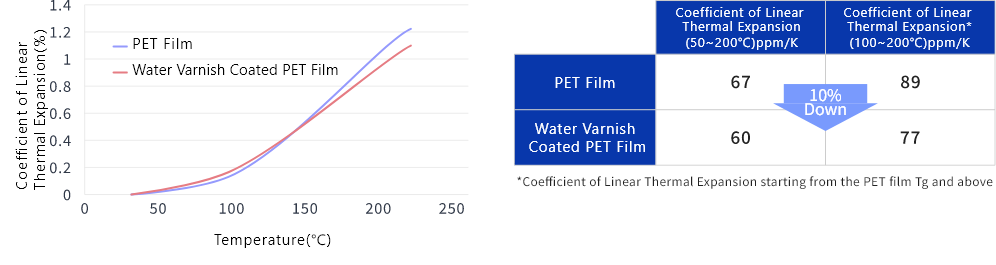
Dimensional Stability is Improved with PET Film × Polyimide
It was confirmed that while heat expansion is observed in PET film alone, applying polyimide improves dimensional stability.
Combining materials, unlocking potential.Exploring the future of composites with UBE.
Contact UBE for sample data and application consulting.
Company Profile HereLet's Surpass Environmental and Social Challenges
Do you think environmentally friendly products are inferior in performance?
Because polyimide water-solvent varnish uses water as its solvent, it can suppress environmental and human health impacts, as well as being an excellent product for energy saving and substrate protection. Furthermore, it does not lose the strength of polyimide even with a water solvent, and it can be used with the same processing methods as conventional NMP-based varnishes.
Three Environmental Benefits
-
Benefit 1
NMP Not Used Because organic solvents are not used, it is possible to reduce the regulatory compliance costs incurred until now.
- NMP recovery equipment
- Explosion-proof equipment
- Maintenance of facility filters
-
Benefit 2
Low VOC NMP, which is commonly used as a solvent for polyimide, has adverse effects on health and the environment.
Water-solvent varnish achieves consideration for the environment and health by reducing NMP solvent use by approximately 80%. -
Benefit 3
Energy Cost Reduction Contributes to the reduction of energy costs through low-temperature curing ( 150℃ and above).
Experience NMP-equivalent performance, even with water
| Water Solvent | NMP Solvent | |||
|---|---|---|---|---|
| Development Product ① | Development Product ② | Development Product ③ |
UBE Standard Grade (UPIA®-AT) |
|
| Film Thickness(μm) | 10 | 10 | 10 | 20 |
| Maximum Heat Treatment Temperature(℃) | 150 | 250 | 350 | 350 |
| Solid Content(wt%) | 18 | 11 | 18 | 18±1 |
| Solution Viscosity(Pa・s) | 3.5 | 2.5 | 4.0 | 5.0±1.0 |
| Density(103/m3) | ー | ー | 1.10 | 1.10~1.11 |
| Storage Conditions(℃) | ≦10 | ≦10 | ≦10 | ≦30 |
| Glass Transition Temperature(℃) | 145 | 210 | 339 | 274 |
| Tensile Strength(MPa) | 106 | 214 | 289 | 229 |
| Elongation Rate(%) | 199 | 164 | 96 | 92 |
| Tensile Modulus(GPa) | 1.9 | 3.2 | 4.6 | 3.7 |
| 5% Weight Loss Temperature(℃) | ー | ー | 574 | 592 |
| Dielectric Breakdown Voltage(kV) | 6※ | 6※ | 7※ | 8 |
※Measured at a film thickness of 20㎛.
An Example of a Processing Method
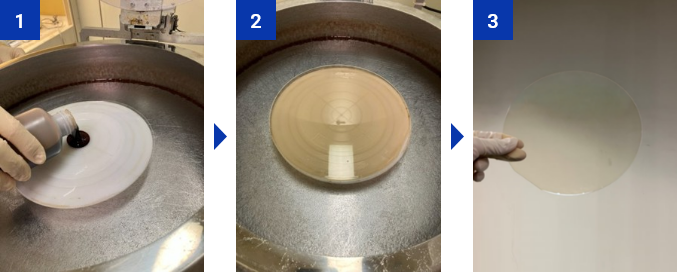
Like NMP-based varnishes, films can be fabricated using the spin coating method.
- Varnish is applied to the substrate
- Is uniformed by spinning
- The film is cured by baking
Potential as vast as your imagination.Partner with us to find your next application.
Contact UBE for sample data and application consulting.
Frequently Asked Questions (FAQ)
-
What other applications can it be used for?
The following applications are anticipated:
- Insulating coating material for magnet wire
- Flexible circuit board material
- Heat-resistant paint/coating
- Dispersant
-
I would like to know the processing method.
The following processing methods are anticipated:
- Slot-Die Coating: Varnish is cast onto the substrate through a slit.
- Dip Coating: The substrate is immersed in the varnish, and the adhered varnish is squeezed off by rollers.
- Spray Coating: Varnish is applied directly and adhered to the material by spraying.