Social Diversity, Equity & Inclusion (DE&I)

Policy and Basic Mindset

Because we aim to become a specialty chemicals company, we know that we have to integrate diverse technologies, expertise, and perspectives to foster innovation so we can overhaul our corporate culture and drive that transformation. We are accordingly fostering gender equality, stepping up recruiting of talented individuals who can hit the ground running, and improving job satisfaction by reviewing our work structure for senior employees. We are also broadening career opportunities for individuals with disabilities.

We conduct surveys and enhance opportunities for dialogues to better understand the needs of individuals while expanding our support programs. This is because we prioritize equity and want our people to flourish.
Management System

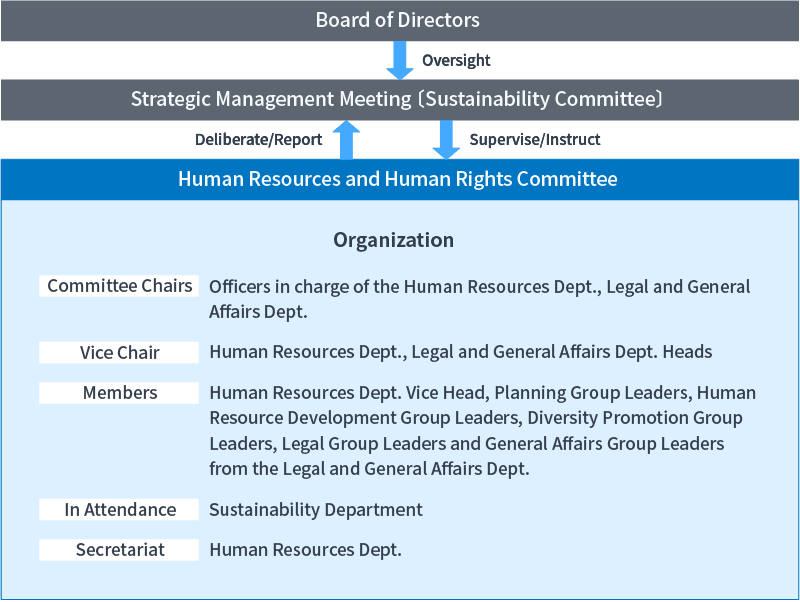
Human Capital Management Operation System

Targets and Performance

Indicators Scope FY2024 FY2025 FY2030 (Mid- Long-Term)
Results Target Target Target
Ratio of women in the workforce (KPI) UBE domestic consolidated companies 16.00% 18% 17% 25%
Ratio of women in managerial roles (KPI) UBE domestic consolidated companies 5.80% 6% 6.50% 10%
Ratio of persons with disabilities in the workforce (KPI) UBE/Libertas Ube/Ube General Service 2.87% 2.70% 3.20%

Initiatives

Diversity in Human Resources

At the UBE Group, we strive to provide stable employment for diverse human resources, regardless of differences in gender, nationality, ethnicity, race, disability, health status, age, social status, family situation, religion, beliefs, gender identity, sexual orientation, employment status, etc.

Employee Data (as of March 31, 2025)
Number of Employees In which, Number of Managers Average Age Average Years of Service
Male 2,380 88.40% 609 93.70% 43.5 16.2
Female 313 11.60% 41 6.30% 40 12.5
Total or Average 2,693 100.00% 650 100.00% 43.1 15.8
Human Resource-Related KPIs (Consolidated Domestic)
(FY) Results Targets
2022 2023 2024 2024
Ratio of women in managerial roles 4.1% 4.6% 5.8% 6.0%
Ratio of women in the workforce 15.0% 15.0% 16.0% 18.0%
Take-up rate of annual leave 74% 81% 81.3% 95%
Ratio of persons with disabilities in the workforce 2.70% 2.68% 2.69% 2.70%
Smoking rate 23% 23% 22.3% 20%

1. Promoting Participation/Talent Pipeline for Women

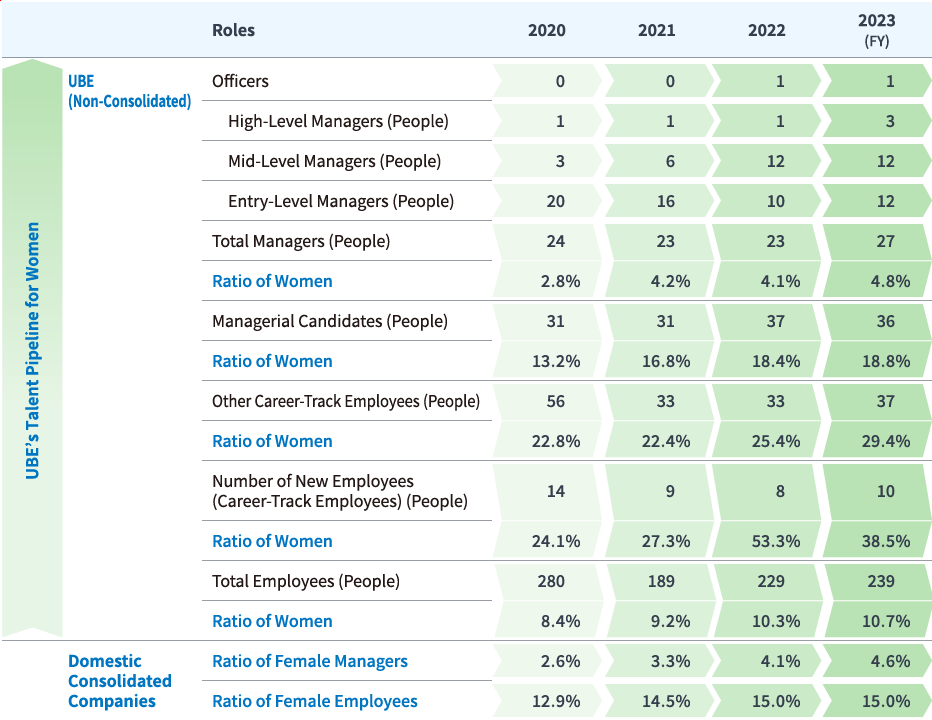
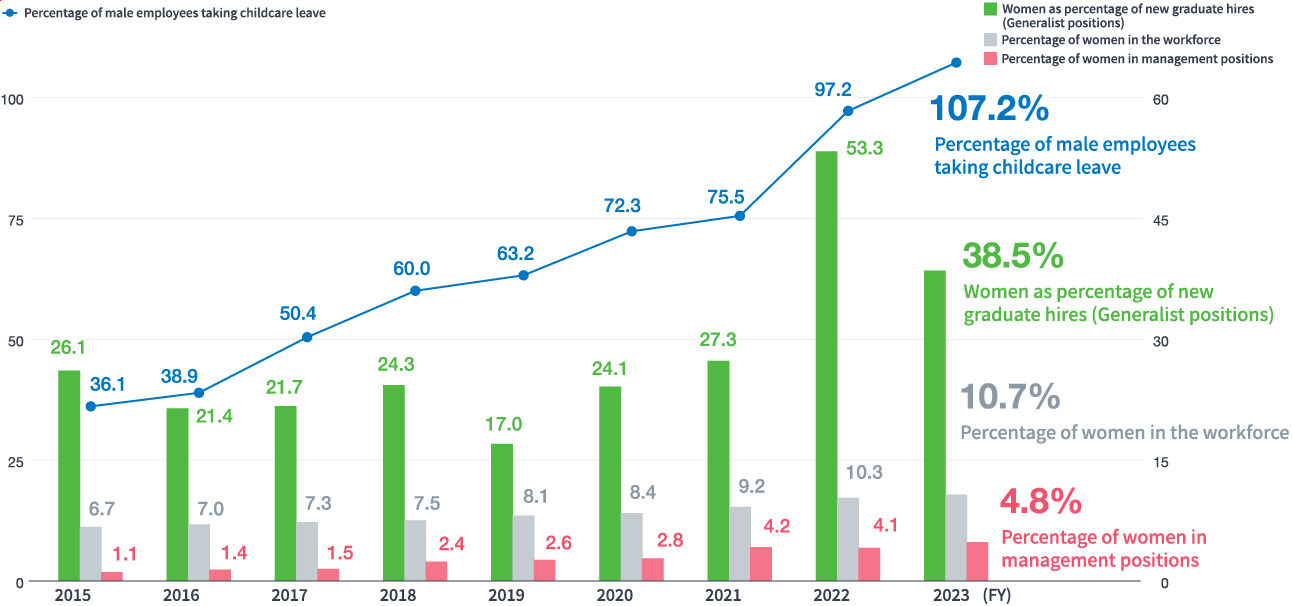
The UBE Group is putting particular effort into promoting the participation of female employees by setting targets for the ratio of women in managerial roles and the ratio of women in the workforce. Through active promotions and education, we are creating a system aimed at empowering women to play key roles in all decision-making efforts. In fiscal 2024, UBE dispatched female staff set to become managers to a cross-industry networking event with the goal of helping them build a positive mindset. Furthermore, in technical positions, we seek to increase the number of women in STEM roles (Science, Technology, Engineering, Mathematics), which is a current social issue. To this end, we are participating in the Yamaguchi University Diversity Promotion Acceleration Consortium and similar programs, cultivating such employees by working in cooperation with educational institutions and local companies. To enhance the ratio of women in the workforce and in managerial roles, we are creating a pipeline for female staff by cooperating with the R&D and Business Development Depts. to step up the mid-career hiring of experienced women with the potential to become immediate assets.

Benchmarks for Providing Greater Opportunities for Women (Parent Company)
figure
  • *The take-up rate for paternity leave among male employees is calculated by taking the number of employees who became fathers in a fiscal year (limited to those who are eligible for paternity leave) as (a) and the number of employees who have started a new period of paternity leave in the same fiscal year as (b), then dividing (b/a). When a child is born in the fiscal year before the one used to calculate (b), but the father takes the leave the following year, the father is included in (b), so there are cases where the take-up rate exceeds 100%.

(1) Formulated a General Business Owner Action Plan Based on the Act on Promotion of Women’s Participation and Advancement in the Workplace

In keeping with the Act on Promotion of Women’s Participation and Advancement in the Workplace, UBE has formulated a General Business Owner Action Plan to create a working environment in which women can participate. We set the following three goals under a three-year plan starting in fiscal 2025.

  1. Ratio of women
    Have women account for 13% or more and 8% or more of our employees and managers, respectively, within the period covered by the plan.
  2. Hiring ratio
    Boost the percentage of women hired (new graduates and mid-career hires) to 25% or more within the period covered by the plan.
  3. Childcare leave
    Bring the take-up rate of childcare leave to the following levels:
    Take-up rate of childcare leave among male employees (annual): 100%
    Number of days of childcare leave taken by male employees: Over 30% of employees taking a leave of 20 days or more within the period covered by the plan

(2) Voluntary Action Plan to Promote Women to Executive and Managerial Positions

To promote women to executive and managerial positions, we have formulated the following Voluntary Action Plan, and are focused on carrying it out. We are expanding individual career development interviews, planned rotations, meetings to exchange opinions with top executives, and other such efforts through the Human Resources Dept.’s “Women Leaders and Managers Education Program,” thereby accelerating the promotions of women to executive and managerial positions. In June 2022, a woman was nominated to the role of Outside Director.

Voluntary Action Plan to Promote Women to Executive and Managerial Positions

Diversity, equity & inclusion underpins our management policies. We are striving to enhance work practice flexibility to cater to diverse personalities and values as well as to hire more women and offer them more opportunities to play active roles in our organization. We formulated the following action plan to increase the proportion of female managers to 15% by the end of fiscal 2030.

  • Appoint women to more than 30% of new graduate career-track positions
  • Implement various measures to foster women’s career advancement
  • Provide unconscious bias training
  • Create a climate that empowers women to expand their job scopes
  • Bolster support programs for childbirth, childcare, nursing care, and other life events and make those programs easily accessible for all female and male employees alike
  • Eliminate long working hours
Shifts in the Number and Ratios of Female Officers and Employees
  • *Values for fiscal 2022 and later include those in “partner employee” positions

(3) Wage Gaps between Men and Women

Difference in male and female wages (Parent company)
(FY) Difference in male and female wages
(Ratio of female to male wages)
2022 2023 2024
All workers 78.80% 78.20% 80.20%
Regular workers 79.40% 79.20% 80.20%
Contract workers 55.80% 57.90% 66.10%
  • Notes:
  • 1.Disparities come from an underrepresentation of women in management-level regular and contract worker positions, so we are striving to hire and promote them.
  • 2.Many women in regular worker positions do not do shift work, leading to wage gaps from not receiving shift and late-night allowances.

(4) Group-Wide Initiatives

The UBE Group’s goal for DE&I is to create innovation by integrating diverse techniques, knowledge, and perspectives. In fiscal 2024, we effectively strengthened our affirmative action efforts regarding the Act on Equal Opportunity and Treatment between Men and Women in Employment and the Act on Promotion of Women’s Participation and Advancement in the Workplace and conducted e-learning on the importance of men taking childcare leave and on striving to balance work with nursing care.

2. Promoting Activity Among Senior Talent

UBE provides career and life planning training for employees once they reach the age of 55 to help them continue working in various workplaces in and outside the Group after reaching the standard retirement age of 60. The aim is to enable them to retain job security by making continued use of their accumulated work expertise and skills, and we provide them with the opportunity to reappraise their lives.

In fiscal 2024, 88.1% of recent retirees were rehired and still remain active within the UBE Group.

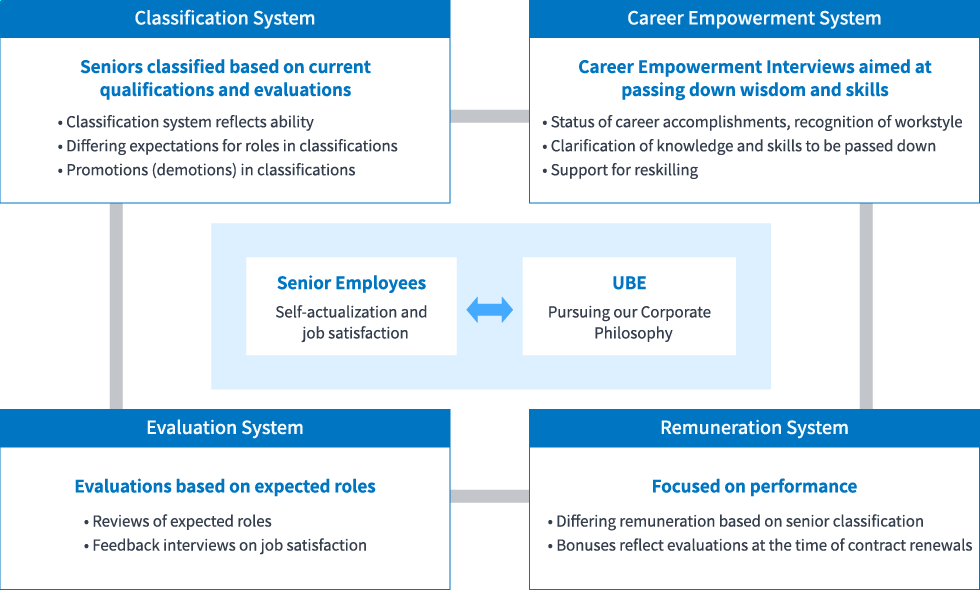
To promote the participation of senior employees, we implemented an evaluation system in fiscal 2024 focused on performance evaluations at time of retirement. Designed for seniors, this system emphasizes transparency, clarifies the roles expected of senior employees, and includes an interview system that sets targets based on the shared acknowledgement of these factors by the individuals and their supervisors as well as an evaluation system that focuses on performance. Notably, we clarified six types of roles we expect senior employees to take on, such as acting as specialists with a high degree of expertise or independently handling important matters in the medium to long term in special situations where younger employees may require support. Moreover, based on our experience providing support for those independently pursuing reskilling, we have devised methods so that these employees may strive toward further self-actualization.

Diagram of Senior Employee Personnel System Structure

3. Employment of Persons with Disabilities

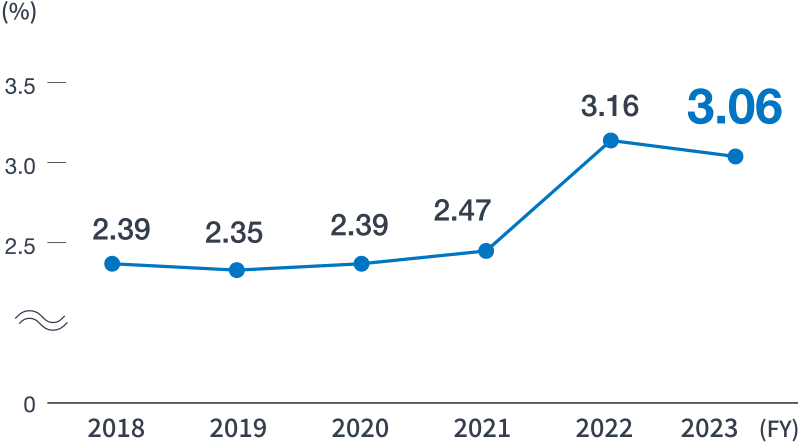
Among its activities since establishing a special-purpose subsidiary for persons with disabilities in 1991, the UBE Group has founded a support network for employing such individuals and developing their skills with the goal of making their hiring an institutional norm within the Group. Furthermore, we have long been expanding their range of duties based on the success of these efforts. Our specialist staff who are certified as corporate job coaches also collaborate with local support agencies to support these individuals as well as their colleagues from the hiring stage onward. Such staff help such individuals enhance their skills in order to expand the scope of their work. For example, persons with disabilities participate in digital talent education and many handle digital operations, including the creation of AI voice data for e-learning, aligning animations and voices, and converting PowerPoint presentation data to e-learning formats. We take care in matching individual strengths to tasks while conducting career development and education. Through these efforts, we practice social inclusion and empower all people to participate.

Rate of Employment of People with Disabilities (UBE and Special-Purpose Subsidiaries)
  • *Average for time frame

4. Recruiting Specialists

In fiscal 2024, mid-career professionals accounted for 51.3% of hires for generalist positions in Japan on a consolidated basis, achieving our goal in the previous Medium-Term Management Plan of 50% or more for fiscal 2024. This reflected efforts to further strengthen timely recruiting and secure specialists with immediately deployable capabilities in line with our business strategies. We will continue to recruit highly specialized talent.

Hiring Breakdown (Parent company)
(FY) 2020 2021 2022 2023 2024
New graduate hires Generalist positions 58 (14) 33 (9) 15 (8) 33 (12) 21 (6)
Key employee positions 69 (10) 36 (7) 32 (0) 38 (9) 24 (4)
Mid-career hires Generalist positions 5 (1) 2 (2) 10 (4) 9 (2) 23 (7)
Key employee positions 13 (0) 11 (1) 22 (3) 14 (0) 28 (2)
Hires of non-Japanese nationals Generalist positions 1 (0) 2 (1) 0 (0) 2 (1) 4 (3)
Key employee positions 0 (0) 0 (0) 0 (0) 0 (0) 0 (0)
  • *Values in parentheses represent the number of female employees

5. Employing Non-Japanese Nationals

To harness expertise from different values and cultures in the face of ongoing globalization, UBE revised the global business leader program to include local training in Japan, Thailand, and Spain, and has expanded personnel exchanges with employees of the UBE Group companies outside Japan. Additionally, every year UBE hires foreign nationals to work in Japan, and actively pursues personnel exchanges, including accepting personnel from international Group companies.