Governance Crisis Management

Policy and Basic Mindset

The UBE Group has established a Crisis Response Committee to respond to four categories of crises affecting the UBE Group or in society at large around it, namely 1) natural disasters, 2) epidemics, 3) overseas emergencies, and 4) misconduct and other crises. This committee deliberates and decides on responses to crises with the potential to greatly impact the business operations of the UBE Group in order to ensure the safety of employees.

UBE Group Basic Policy for Business Continuity

The UBE Group recognizes significant risks to its business operations, such as the Tokyo Metropolitan Earthquake, the spread of infectious diseases, and other major threats. In the event of such risks, we minimize their impact, place the highest priority on the safety of employees, build trust with customers and local communities, and ensure rapid recovery of business operations.

Scope

This policy applies to the UBE Group (UBE Corporation and its consolidated subsidiaries).

Goal

In the event of a crisis that has or may have a significant impact on the UBE Group’s business operations, we will respond promptly and appropriately, minimize the impact, and restore business operations as soon as possible. To achieve this, we will implement the following measures.

  1. Ensuring the safety of human life
    In the event of significant risks such as the Tokyo Metropolitan Earthquake, the spread of infectious diseases, and other major threats, we respect the lives of employees and related parties, and act with the highest priority on ensuring safety.
  2. Early recovery and continuation of business
    We minimize damage to assets necessary for business continuity, and strive for the early recovery and continuation of each business. We also minimize the impact on customers, local communities, and other stakeholders, and take appropriate measures to earn and maintain trust in the Group.
  3. Operation of the BCP (Business Continuity Plan) during normal times to improve effectiveness
    We continuously provide BCP education and training during normal times to improve the effectiveness of our BCP.

Commitment

  • In responding to major risks such as large-scale natural disasters, infectious diseases, and overseas emergencies, we place the highest priority on ensuring the safety of life and minimizing human casualties.
  • The UBE Group sets its target as restoring normal operations by the fourth day after the occurrence of a large-scale earthquake. Based on the BCP, we establish necessary systems as appropriate and regularly conduct drills simulating various scenarios.

Responsible Departments and Review

The General Affairs Department is responsible for overseeing and managing this policy.

This Policy is subject to regular review at least once every year. Any revisions, whether as part of a scheduled review or required during the fiscal year, will be deliberated and approved by the Crisis Response Committee.
Management System

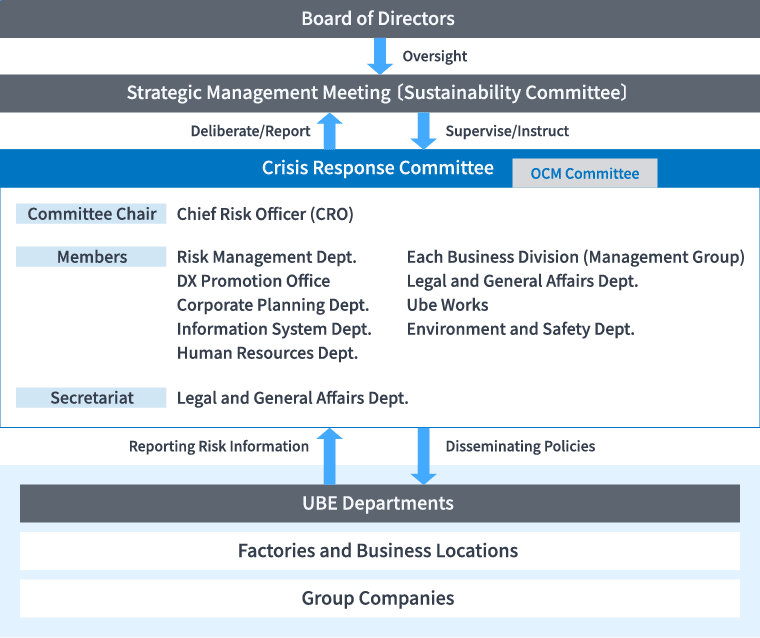
Based on our Group Crisis Response Regulations, we established the Crisis Response Committee as a Company-wide interorganizational entity headed by the Chief Risk Officer (CRO). This committee meets regularly to foster awareness of crisis responses as well as to revise action plans, BCPs and manuals. We also established a subcommittee known as the Overseas Crisis Management (OCM) Committee to manage the safety of local staff and their families as well as handle crisis responses at our overseas bases.

We have formulated Standards for First Responses in the Event of Accidents or Disasters as the basis of a checklist to be used when responding to incidents and have set up a reporting line to connect offices and facilities to people in charge at our Head Office should disaster strike, thus enabling rapid reaction to crises and efficient reporting systems.

System Overview
figure

Crisis Response Committee Duties

  • Deliberate and decide on basic matters related to responses to the following four categories of crises that would greatly impact the UBE Group’s business operations and society at large.
    1. Natural disasters
    2. Epidemics
    3. Overseas emergencies
    4. Misconduct and other crises
  • Direct the creation, compilation and management of manuals regarding these four types of events, starting with BCPs, for the UBE Group. Additionally, conduct inquiries and establish systems for Company-wide responses and mechanisms in the event of such an incident.

OCM Committee Duties

  • Properly disseminate knowledge on such events as overseas security situations and trends in epidemics at proper times, and prepare overseas emergency response manuals for the UBE Group in preparation for such incidents.
  • Prior to dispatching staff scheduled for overseas postings and their accompanying families, provide education on such matters as the security situation in the country of posting. Also, provide ongoing health management support for staff posted overseas as well as those on long-term business trips.
  • Conduct on-site risk inspections at overseas locations and residences of local staff through consultants

Targets and Performance

Metrics Scope
Smoothly maintain and continue operations for UBE Group businesses based on BCPs UBE Group (UBE Corporation and consolidated subsidiaries)
Maintain relationships of trust with such stakeholders as customers and local communities UBE Group (UBE Corporation and consolidated subsidiaries)
Place the highest priority on ensuring the safety of people’s lives and minimizing casualties in the event of large-scale natural disasters, epidemics, or emergencies overseas UBE Group (UBE Corporation and consolidated subsidiaries)
Restore normal business operations by the fourth day after a large-scale earthquake UBE Group (UBE Corporation and consolidated subsidiaries)

We understand the considerable risk to business operations posed by crises, especially in the case of natural disasters such as large-scale earthquakes in the Tokyo metropolitan area or torrential rains as well as by the spread of novel epidemics, and we work to minimize impacts should they occur, with the safety of employees and building trust with customers and local communities at the forefront of such efforts. To enable the swift recovery and maintenance of operations, we have established a Group Business Continuity Plan Basic Policy. This policy naturally includes “ensuring the safety of human life” and the “swift recovery and maintenance of operations” along with the major theme of taking “regular actions to increase the efficacy of BCPs,” which encompass improvement through continuous education and drills in non-crisis times.

As part of our BCP measures, we have compiled a Head Office Natural Disaster Response Manual, which provides Head Office employees with response policies and instructions for action. This manual stipulates that, should a large-scale earthquake in the Tokyo metropolitan area cause the Head Office to sustain damage, rendering it only partially functional, we will shift Head Office functions to such major locations as Ube Works. At the same time, a disaster response headquarters will be set up to quickly establish a chain of command, while emergency customer response centers will be launched to address our customers’ needs swiftly and properly. We have also formulated BCPs for each UBE business and department in preparation for the spread of epidemics and large-scale damage to factories.

By formulating and revising these BCPs, we minimize the impact of natural disasters and epidemics while placing the utmost priority on securing the safety of employees and building trust with customers and local communities. In these ways we are striving to enable the swift recovery and maintenance of operations.

Initiatives

Natural Disasters

We have established a Crisis Response Committee and a Natural Disaster Countermeasure Committee, created response manuals and other such materials for when a disaster occurs, conducted planned maintenance and improvements to building and manufacturing equipment, carried out regular disaster drills, and ensured that employees are provided with appropriate instruction. To swiftly restore operations when natural disasters strike, we have formulated BCPs that we regularly revise and conduct drills for. For events considered to be of particularly high concern, for example, a large-scale earthquake in the Tokyo metropolitan area, we have devised an overhead view table of first responses to such an event, and have disseminated information at offices and facilities on action guidelines covering a time frame from just after the event occurs to three days later.

Spread of Epidemics

We have formulated a Novel Disease Response Manual that categorizes responses within five periods, namely non-occurrence, overseas cases, early domestic cases, domestic epidemic, and lull. We disseminate this knowledge throughout the Group; regularly revise BCPs at offices and facilities; and designate thorough disease prevention measures, appropriate responses regarding contagious individuals, and methods as well as response policies for business continuation, thus building flexibility in accordance with disease conditions into our responses. The Crisis Response Committee also collects timely information regarding the status of foreign and domestic pandemics, governmental and municipal responses and policies, and on the status of contagious individuals within the Group. It also creates action and response policies to prevent infections among employees as needed while conducting other such measures to minimize impacts on business activities.

Overseas Crisis Management (OCM)

In order to quickly respond to emergency conditions in our overseas business expansion regarding such events as deteriorating governmental or economic conditions and social unrest stemming from wars, conflict, terrorism, etc., abroad, we have established the OCM Committee as a subcommittee of the Crisis Response Committee to create manuals on such concepts as gathering information and emergency responses. Through the effective use of expert consultation, this committee has also created systems to gather requisite information and share it in a timely and appropriate manner with our locations in affected countries. Furthermore, it establishes disaster response headquarters when necessary, and as it seeks to quickly and properly address matters while prioritizing employee health, it regularly conducts safety inspections at overseas bases and the residences of local staff through consultants.