Environmental Contributing to the Conservation and Restoration of the Natural Environment (Nature Positive)

Policy and Basic Mindset

UBE Group Basic Policy for Nature Positive

The UBE Group will contribute to solving global environmental problems by focusing on Carbon Neutrality, Circular Economy, and Nature Positive (conservation and reconstruction of the natural environment).

Nature Positive means halting the loss of biodiversity, which is an intrinsic property of nature, and putting nature on a path to recovery. The UBE Group's corporate activities may have an impact on nature. It is necessary to reduce this impact in our own manufacturing and value chain, and to restore degraded natural environments.

The UBE Group will contribute to the conservation and restoration of the natural environment and the sustainable use of ecosystem services by first understanding its dependence on and impact on nature in its business activities, and by identifying risks and opportunities.

Scope

This policy applies to the UBE Group (UBE Corporation and its consolidated subsidiaries) and covers the entire value chain.

Goal

Contributing to the realization of Nature Positive

Commitment

  • We will continuously monitor the emissions of pollutants (air pollution, water pollution, soil pollution, etc.) generated in our operations and strive to control emissions.
  • We will identify and assess water risks at our main business sites and strive to conserve and effectively utilize water resources that are important to our business.
  • In order to reduce the environmental impact of the entire supply chain, we will engage with stakeholders.
  • We will fulfill our commitment to Carbon Neutrality and the realization of Circular Economy.
  • We will continue to engage with suppliers who account for the top 50% or more of the raw material procurement volume and will further enhance the scope engagement in the future.

Responsible Departments and Review

The Sustainability Department is responsible for overseeing and managing this policy.

This Policy is subject to regular review at least once every year. Any revisions, whether as part of a scheduled review or required during the fiscal year, will be deliberated and approved by the Environmental Issues Committee.

  • *Materials on the UBE Group’s basic mindset and the status of activities related to contributing to the conservation and restoration of the natural environment (nature positive)
Targets and Performance

Metrics Scope Results Targets
FY2024 FY2030
Reduction of chemical substance emissions
Reduction in emissions of 20 chemical substances from FY2010 levels
Group (domestic) 38% 70%
Reduction of waste emissions
Reduction of industrial waste sent to external landfills from FY2000 levels
Group (domestic) 92% 95%

We are continuing with measures to disclose information based on the TNFD Recommendations to become Nature Positive.

Initiatives

Suppressing Chemical Substance Emissions

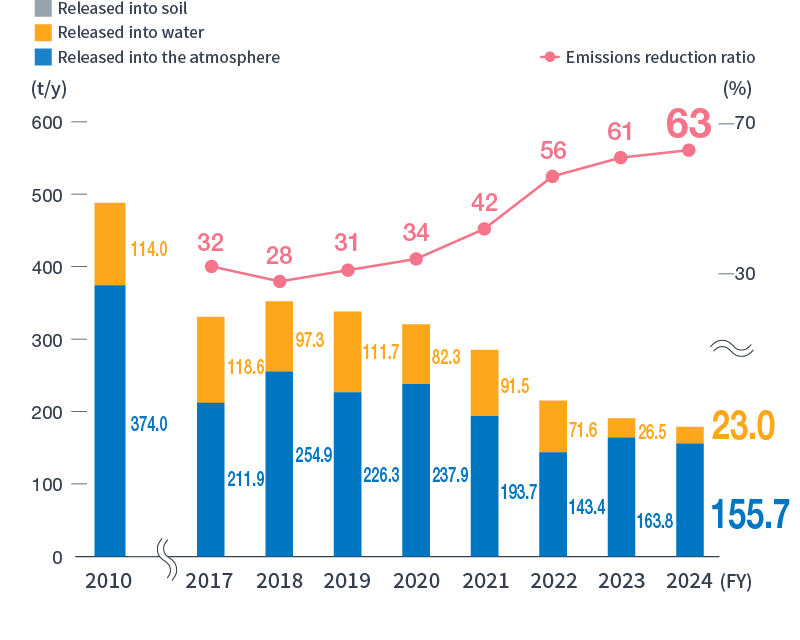
  • Emissions Volume of PRTR Substances
    Emissions Volume of PRTR Substances
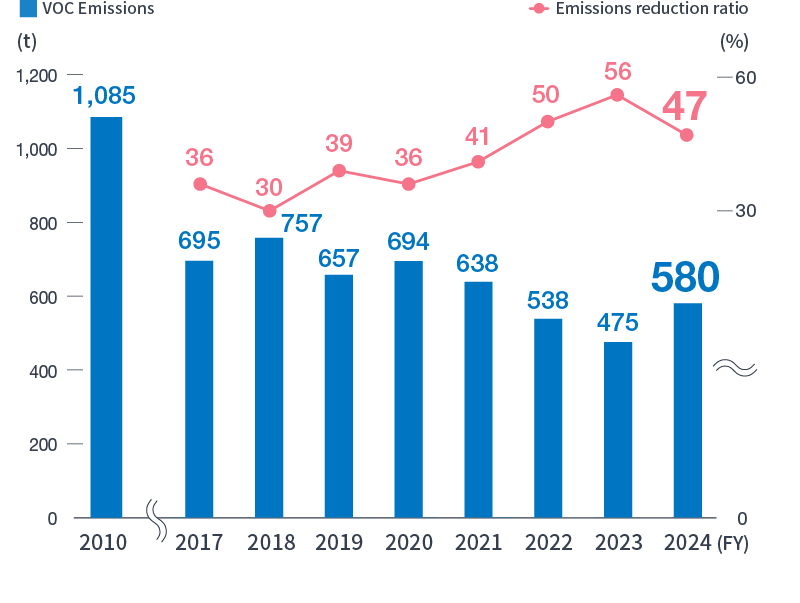
  • VOC Emissions
    VOC Emissions
  • Scope of coverage: UBE’s domestic factories, laboratories, and key consolidated subsidiaries with manufacturing plants, representing 70% of such subsidiaries

Total Emissions of 20 Chemical Substances

Fiscal 2030 Target: 70% reduction from the fiscal 2010 level

The UBE Group accorded Companywide priority to 20 key chemical substances*1 with high emission volumes from among those subject to the PRTR Law*2 and VOCs,*3 and endeavors to control their emissions. By fiscal 2024, we had reduced the total emissions of 20 chemical substances by 38%. We will continue to cut our emissions.

  • *120 chemicals selected independently: Methyl alcohol, butyl alcohol, toluene, epsilon-caprolactam, styrene, ammonia, cyclohexane, cyclohexanone, oxalic acid, vinyl acetate, xylene, n-hexane, ethylbenzene, chloromethane, benzene, dimethyl phthalate, N,N-dimethylacetamide, boric acid compound, phenol, hydrogen fluoride and its water-soluble salts
  • *2Pollutant Release and Transfer Register (PRTR) Law: This legislation requires companies to identify business site chemical substance emissions and transfer volumes and report to the government. The Ministry of the Environment discloses the submitted information on its website. Such disclosure is designed to encourage voluntary efforts to improve chemical substance management.
  • *3Volatile organic compounds (VOCs): These organic chemicals evaporate or sublimate easily, entering the atmosphere as gases. They are factors in the forming of suspended particulate matter (PM) and photochemical oxidant pollution.

Response to the Fluorocarbon Emission Restriction Law

Promulgated in April 2015, the Act on Rational Use and Appropriate Management of Fluorocarbons is aimed at reducing leaks of fluorocarbon refrigerants (chlorofluorocarbon, hydrochlorofluorocarbon, and hydrofluorocarbon) to help prevent global warming and the further destruction of the ozone layer. We comply strictly with laws and regulations relating to chlorofluorocarbon refrigeration and air conditioning equipment inspections. We endeavor to prevent fluorocarbon leaks by improving their recovery and filling methods and strengthening equipment operations management.

We are systematically replacing chlorofluorocarbon refrigeration equipment from our processes with alternatives that use low global warming potential hydrofluorocarbons or non-chlorofluorocarbon refrigerants.

Polychlorinated Biphenyl (PCB) Waste Disposal

We thoroughly audit stabilizers and other equipment using PCBs. In addition, we are endeavoring to complete PCB waste disposals by the deadline set under the amended Act on Special Measures concerning Promotion of Proper Treatment of PCB Wastes. We comply with storage and disposal laws and ordinances for processing waste in addition to utilizing Japan Environmental Storage & Safety Corporation (JESCO) and certified detoxification contractors to systematically dispose of PCB waste.

Number of Units of Equipment Incorporating PCBs in Storage (As of April 2024 for UBE Corporation)
(Units)
In Use In Storage Total
High-concentration PCB 0 0 0
Low-concentration PCB 23 26 49

UBE Corporation completely disposed of high-concentration PCB waste in fiscal 2021. It is endeavoring to systematically collect and dispose of all low-concentration PCB waste by the deadline set under the amended Act on Special Measures concerning Promotion of Proper Treatment of PCB Wastes.

Reducing Industrial Waste

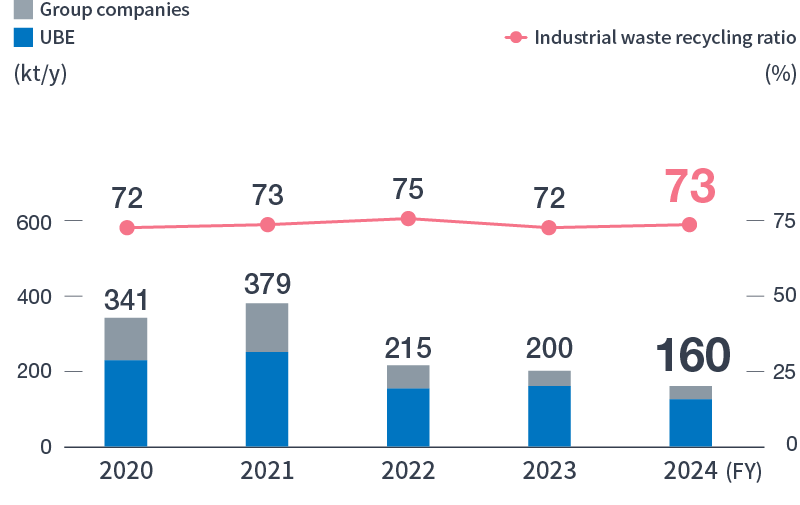
  • Industrial Waste Recycling Amount
    Industrial Waste Recycling Amount
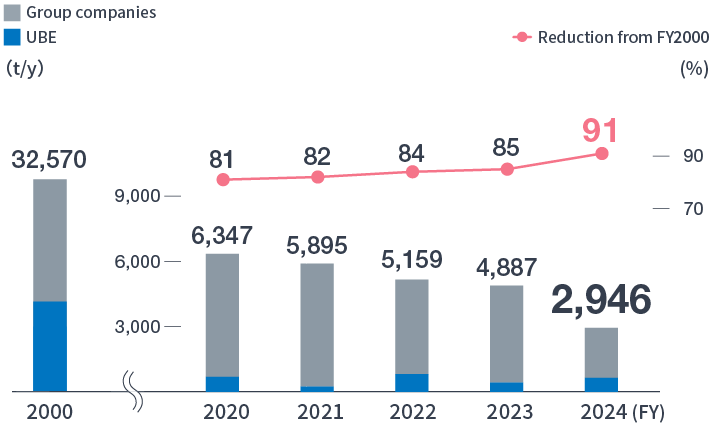
  • Industrial Waste for External Final Disposal
    Industrial Waste for External Final Disposal
  • Scope of coverage: UBE’s domestic factories, laboratories, and key consolidated subsidiaries with manufacturing plants, representing 70% of such subsidiaries

Industrial Waste for External Final Disposal

Fiscal 2030 target: 95% reduction from fiscal 2000 level

The UBE Group is reducing and recycling industrial waste to help create a circular economy. By fiscal 2024, we had cut waste sent to external landfills by 92% from fiscal 2000 levels. We will keep striving to reduce industrial waste.

Information Disclosure Based on the Taskforce on Nature-related Financial Disclosures (TNFD) Recommendations

The UBE Group recognizes the importance of biodiversity and the natural environment. It understands the dependencies and impacts of its business activities on nature and conducts corporate management that contributes to the resolution of global environmental issues. In its promotion of initiatives and establishment of organizations toward that purpose, the Company utilizes the framework provided by the TNFD to organize its initiatives and the results of its analyses.

In fiscal 2024, the UBE Group investigated and evaluated nature-related dependencies and impacts based on the LEAP Approach, a method for analysis provided by the TNFD, which encompassed all Group (consolidated) domestic factory locations.

Evaluating dependencies and impacts at each factory location

We evaluated the status of dependencies and impacts using the external tool ENCORE. This evaluation revealed that we have an extensive relationship with water resources and thus the potential for substantial environmental impacts due to chemical substance emissions. It is important to maintain an awareness of this relationship when pursuing the UBE Group’s main business activities.

Investigations of priority areas

Using external tools including Global Forest Watch, IBAT, Aqueduct, and GLOBIO Model, we investigated points of intersection between areas defined as being priorities by the TNFD and factory locations. The results showed a need to pay attention to biodiversity preservation at locations along the coastlines in Yamaguchi Prefecture and Fukuoka Prefecture.

Identifying and evaluating nature-related risks and opportunities

The results of evaluations done via external tools as well as the results of quantitative evaluations of actual indicators related to dependencies and impacts are taken into account when seeking to discover risks and opportunities as well as evaluate their importance. These efforts are accomplished through the use of the TNFD risk and opportunity registers, guidance for individual sectors, and the WWF’s Risk Filter Suite.

Scenario analysis

In accordance with the guidance of the TNFD, we anticipated a scenario involving the smooth progression of market understanding toward the realization of a nature positive outcome as well as another scenario covering the sudden establishment of regulations due to a higher-than-expected level of deterioration in the natural environment at locations near operating sites.

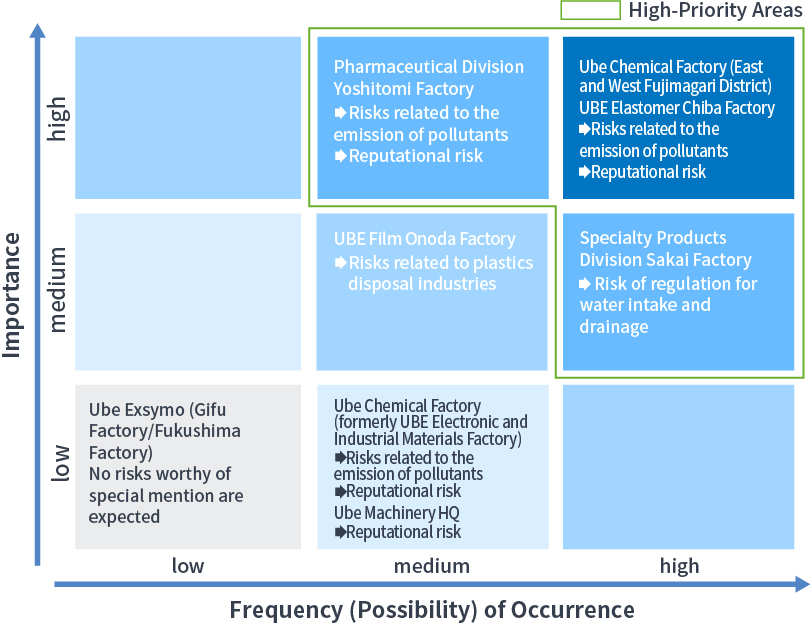
Matrix mapping (evaluating importance)

We have determined two axes for evaluating the priorities of each nature-related risk and opportunity, namely “importance” and “frequency (possibility) of occurrence.” Comprehensive quantitative evaluations cover the “importance” of the main activities at sites (water usage/wastewater amounts, harmful material emissions, etc.), the presence of points of contact with priority areas, the size of operational risk evaluation indexes via Risk Filter Suite, and more. Qualitative evaluations regarding the frequency (possibility) of occurrence are carried out while taking scenario analysis into account.

At locations where both of these evaluation axes are prioritized, we select four locations within the matrix as high-priority regions where initiatives take precedence over other efforts.

Matrix Mapping (Evaluating Importance)
Matrix Mapping

Key priority areas and issues

We have compiled lists of business activities by key priority areas, key issues, and the direction of responses in a table after accounting for analyses and inquiries done via the LEAP Approach and matrix mapping.

Key Priority Areas Relevant Locations Main Business Activities Key Issues Direction of Responses
Ube, Yamaguchi
Suonada Sea coastline
UBE Corporation
Ube Chemical Factory East and West Areas
Ube Chemical Factory Fujimagari Area
Manufacture of specialty (chemical) products
  • Water pollution near basins
  • Emission of toxic chemical substances into basins
  • Improving disaster resilience
  • Potential strengthening of environmental laws and regulations
  • Regional reputational risk
  • Thorough monitoring, maintenance, and disclosure on the status of emissions of harmful substances
  • Thorough management of harmful substances in consideration of BCP measures and damage from disasters
  • Communication and partnership with local governments and environmental conservation communities
Yoshitomi, Fukuoka
Buzen Sea coastline
UBE Corporation
Yoshitomi Factory
Manufacture of pharmaceutical products
  • Water pollution near basins
  • Emission of toxic chemical substances into basins
  • Improving disaster resilience
  • Potential strengthening of environmental laws and regulations
  • Regional reputational risk
  • Thorough monitoring, maintenance, and disclosure on the status of emissions of harmful substances
  • Thorough management of harmful substances in consideration of BCP measures and damage from disasters
  • Communication and partnership with local governments and environmental conservation communities
Ichihara, Chiba UBE Elastomer Co. Ltd.
Chiba Factory
Manufacture of resins and synthetic rubber materials
  • Water pollution near basins
  • Emission of toxic chemical substances into basins
  • Improving disaster resilience
  • Use and disposal of plastics
  • Potential strengthening of environmental laws and regulations
  • Thorough monitoring, maintenance, and disclosure on the status of emissions of harmful substances
  • Thorough management of harmful substances in consideration of BCP measures and damage from disasters
  • Understanding and responding to the laws and regulations enforced in or being considered by the countries and local governments related to our value chain
Sakai, Osaka UBE Corporation
Sakai Factory
  • Emission of toxic chemical substances into basins
  • Improving disaster resilience
  • Use and disposal of plastics
  • Potential strengthening of environmental laws and regulations
  • Thorough management of harmful substances in consideration of BCP measures and damage from disasters
  • Understanding and responding to the laws and regulations enforced in or being considered by the countries and local governments related to our value chain

Future initiatives

In fiscal 2024, we identified key priority areas and issues via the LEAP Approach. We will continue to gather data and establish KPIs and targets to promote information disclosure based on the TNFD Recommendations. Following this, we will also proceed with efforts to manage our overseas locations, apply this approach to the upstream value chain, etc., in order of priority.

Conservation of Water Resources

Water, the procurement of which is dependent on natural sources, is used in a variety of ways within the chemical industry, such as in heating media (refrigeration, steam), solvents and cleaning. Water resources are therefore important to the UBE Group.

Based on information obtained using World Resources Institute’s Aqueduct tools for evaluating water risk around the world, we assessed and classified water risk at important business locations, and were able to confirm that none of our locations are excessively dependent on water resources deemed to be of high risk.

To prepare for the possibility of increased water stress after 2030 at our locations in Thailand and Spain, we have set target rates for reducing the amount of water used per unit of production and for water recycling, and we are proceeding with various approaches accordingly.

Water Risk Assessment Results

Information obtained using Aqueduct and other tools supplements data gained from on-site locations has enabled us to classify water risk at major business locations into the five rankings shown below.

No water was taken from high-risk fresh water sources.

Risk Level Percentage of Total Water Intake Volume Location Main Cause of Risk
High 0% N/A
Medium-High 0% N/A
Medium 3% Important locations in Thailand, etc. Tight supply and demand of water, drought
Medium-Low 1% Important locations in Spain Flooding
96% Important locations in Japan
Low 3% N/A

Moreover, because water stress will tend to rise after 2030 at important locations in Thailand and Spain, we are proceeding with responses targeted by the following KPIs.

Location KPI
Important locations in Thailand Reduce the percentage of water used per unit of production (compared to FY 2021) FY 2024 5% decrease FY 2024 results 11% increase
Water recycling rate FY 2024 26% FY 2024 results 35.1%
Important locations in Spain Reduce the percentage of water used per unit of production (compared to FY 2022) FY 2030 10% decrease FY 2024 results 16.5% decrease
Water recycling rate FY 2030 10% FY 2024 results 0%

Initiatives Related to the UBE Group’s WASH Measures

We are proceeding with WASH (Water Access, Sanitary and Hygiene) measures related to SDG Goal 6; ensure availability and sustainable management of water and sanitation for all. WASH measures are aimed at providing everyone in the world with access to safe drinking water, handwashing water, and such hygienic equipment as modern toilets.

In the UBE Group, we outfit our locations with WASH environments, and our offices and facilities are setting goals to address employee health and establish a healthy working environment.

  • Setting WASH targets (safe water for drinking, handwashing, and hygienic equipment such as modern toilets) at all locations
  • Enacting water-saving measures such as installing sensors on faucets at handwashing stations (Sakai Factory)
  • Renewing water supply equipment and being thorough in wastewater management (UBE Machinery Group)
  • Permanent mineral water server (Head Office)

Among the eight targets included in SDG 6, the UBE Group is able to contribute to the realization of targets 6.3*1 and 6.4,*2 and we are proceeding with such responses through legal compliance and setting goals.

  • *1SDG target 6.3: By 2030, improve water quality by reducing pollution, eliminating dumping and minimizing release of hazardous chemicals and materials, halving the proportion of untreated wastewater and substantially increasing recycling and safe reuse globally.
  • *2SDG target 6.4: By 2030, substantially increase water-use efficiency across all sectors and ensure sustainable withdrawals and supply of freshwater to address water scarcity and substantially reduce the number of people suffering from water scarcity.

Conservation of Biodiversity

Based on the Integrated Biodiversity Assessment Tool (IBAT) and information from important business locations, we verify the proximity of each site to nature conservation areas and key biodiversity conservation areas in addition to always determining the potential of impacting such areas and the severity of said impact.

  • No locations border Ramsar Sites.
  • The areas in Ube District that are adjacent to sea level have been designated protected areas corresponding to Management Category VI by the International Union for Conservation of Nature (IUCN).
  • Fishing rights have been established for the areas in Ube District adjacent to seas in accordance with national regulations.
  • The Koto River Estuary, which is adjacent to the Fujimagari District in Ube, is one of the 500 wetlands in Japan determined to be of high importance with regard to biodiversity by the Japanese Ministry of the Environment and is designated No. 400: Koto River, Ariho River and Asa River Estuary (salt marsh, river, tidal flats, and brackish water). This makes it a Key Biodiversity Area (KBA) where conservation is vital (Suonada Sea, Kotogawa Estuary). The Ministry of the Environment also states that the Koto River Estuary’s tidal flats comprise an “Ecologically or Biologically Significant Marine Area” (EBSA). We do not directly release pollutants in this or other marine areas.

Forestation Activities

  • Took part in forestation initiatives (Sakai Factory)
  • Conducted environmental seminars within the factory (Sakai Factory)
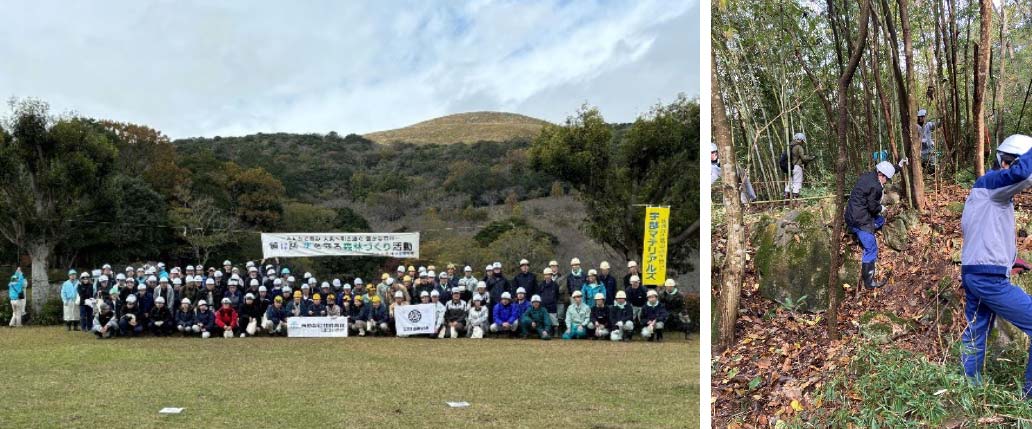
  • Participated in the city of Mine’s Agriculture, Forestry and Fisheries Office’s forestation initiatives to protect water (Ube Chemical Factory)
photo
Employees participated in the 17th Forest Creation Experiential Activity for Water Conservation

Measures regarding invasive species

  • Conducted exterminations of Argentine ants (an invasive species), made administrative reports, and took measures to prevent infestations from spreading beyond business sites (Ube Chemical Factory)

Marine Plastic Waste

  • Undertook joint cleanups with neighboring companies (Sakai Factory)
  • Discussed the closed loop recycling of plastic bottle caps (UBE Machinery Group)
  • Participated in year-end street cleanup that an Ube City volunteer group organizes (Ube Chemical Factory)
  • Patrolled waste storage sites every quarter (Ube Chemical Factory)
  • Promoted plastic recycling (Ube Chemical Factory)